Weight that will not move - when everything seems to stall
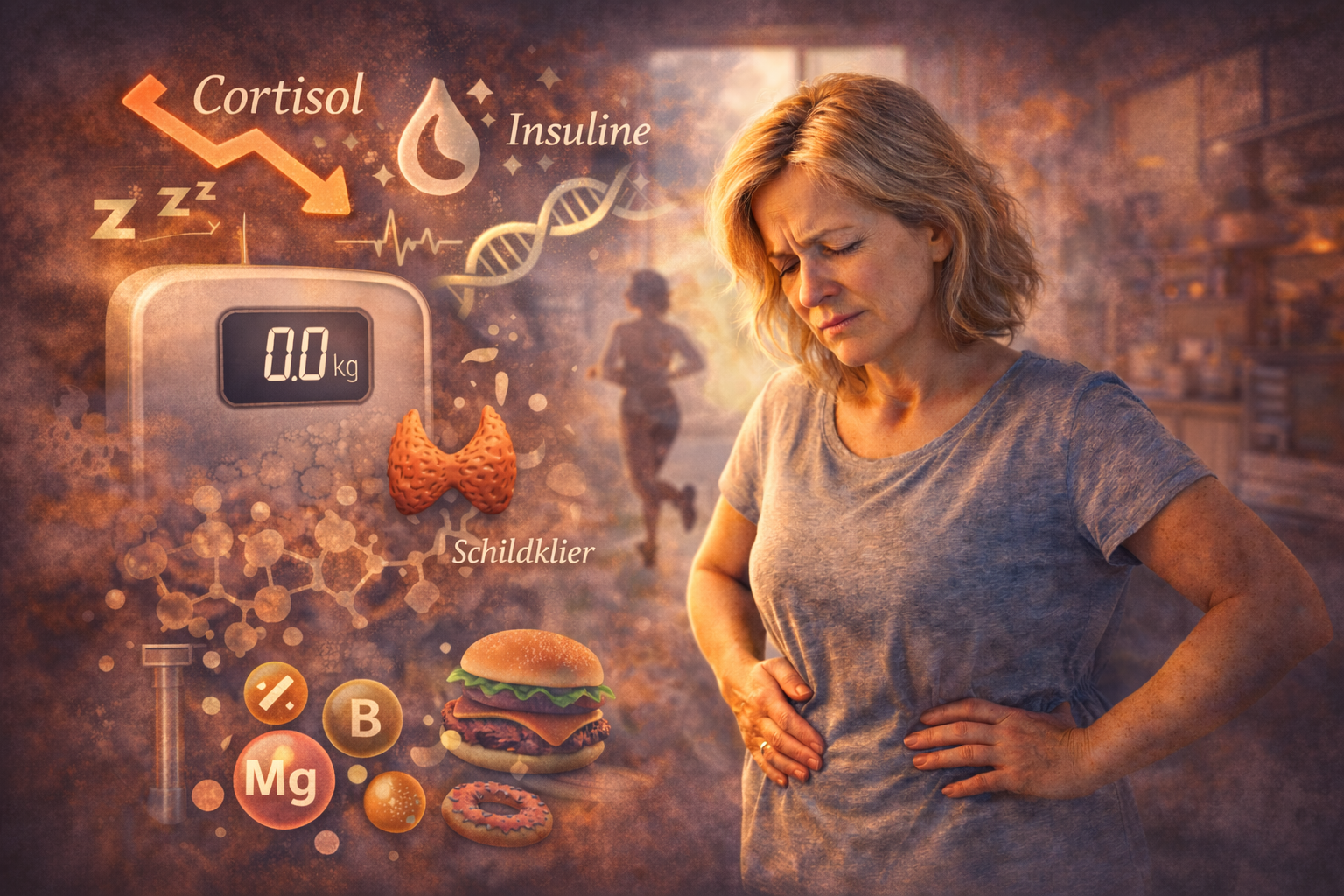
You pay attention to what you eat.
You move more than you used to.
Maybe you have already tried different diets.
And still... the number on the scale stays the same.
Or your weight slowly creeps up, even though you feel you are not eating more than before.
For many people, this is extremely frustrating. You do your best, but it feels like your body is no longer cooperating.
What is often overlooked: weight is not only determined by willpower or calories, but also by a complex interplay of hormones, stress, sleep, nutrition, and metabolism.
Within orthomolecular and hormonal medicine, we therefore look not only at what you eat, but especially at what is happening inside your body.
Losing weight is not a simple equation
For a long time, weight loss was seen mainly as:
eat less + move more
But more and more research shows the body responds in a far more complex way. Metabolism adapts, hormones change, and the body may even try to hold onto energy when it feels "unsafe".
Researchers from institutions such as Harvard School of Public Health and the Mayo Clinic describe how hormonal signals like insulin, leptin, and ghrelin play a major role in appetite, fat storage, and energy expenditure.
In other words: your body has an internal regulatory system that determines how much energy you store or burn.
When that system becomes imbalanced, it can feel like you are up against an invisible wall.
Possible reasons why weight no longer moves
1. Blood sugar and insulin
Insulin is a hormone that plays an important role in fat storage.
When blood sugar spikes frequently - for example due to fast carbs, stress, or irregular eating - the body produces more insulin. This can make it harder to access fat reserves.
Research published in journals such as The New England Journal of Medicine shows that insulin resistance can be an important factor in weight gain and difficulty losing weight.
2. Chronic stress and cortisol
Long-term stress increases production of the stress hormone cortisol.
Elevated cortisol can lead to, among other things:
- more fat storage (especially around the abdomen)
- more cravings for sugar and quick energy
- a slower metabolism
Studies from institutions such as Yale University show a clear relationship between chronic stress, weight gain, and fat distribution.
3. Sleep deprivation
Sleep may be one of the most underestimated factors in weight regulation.
When you sleep too little or poorly, hormones that regulate appetite change:
- ghrelin (hunger hormone) rises
- leptin (satiety hormone) falls
Research from the University of Chicago Sleep Research Center shows that sleep deprivation can increase hunger and affect metabolism.
4. Thyroid and hormonal balance
The thyroid plays an important role in metabolic speed.
If thyroid activity decreases, it can lead to:
- fatigue
- weight gain
- difficulty losing weight
Hormonal changes around menstruation, pregnancy, or menopause can also influence weight and fat distribution.
5. Gut health
A relatively new research area is the role of the microbiome - the bacteria in our gut.
Studies published in Nature and Cell Metabolism show that gut flora composition can influence:
- energy extraction from food
- inflammatory processes
- fat storage
This helps explain why two people can eat the same way but respond differently in terms of weight.
New insights and promising developments
Metabolic flexibility
Researchers increasingly study the body's ability to switch between sugar and fat burning. This is called metabolic flexibility.
When this system is disrupted, the body often remains dependent on quick energy and uses fat less efficiently as fuel.
Light, rhythm, and circadian biology
More and more studies show that daylight, sleep rhythm, and meal timing influence hormones and metabolism.
Researchers at the Salk Institute for Biological Studies are exploring, for example, how time-restricted eating can support metabolism.
Cold, movement, and mitochondria
So-called "out-of-the-box" interventions are also getting research attention, such as:
- cold exposure
- specific strength training
- breathing techniques
- improving mitochondrial energy production
These approaches focus on activating metabolism and improving cellular energy management.
Why a personal approach is so important
When weight no longer moves, the cause is rarely one single factor.
Often it is a combination of:
- nutrition
- hormones
- stress
- sleep
- gut health
- lifestyle
In an orthomolecular and hormonal approach, we therefore look at the full picture.
Not only calories, but what your body needs to come back into balance.
Your body is not working against you
Many people feel guilty when weight loss does not work.
But in reality, your body is often trying to protect you. It responds to stress, deficiencies, or hormonal signals that indicate energy should be conserved.
When underlying systems come back into balance, the body often starts responding differently on its own.
Not by fighting your body harder, but by working with its biology.
✨ Do you recognize that your weight has been stuck for a long time despite your efforts?
Then it may be valuable to look deeper at what is happening beneath the
surface.
When you understand what is blocking your body, there is often room for
change again.